How Many Pages Is My Book? Words per Page by Trim Size
November 21, 2026 · Equipo Style Optimizer
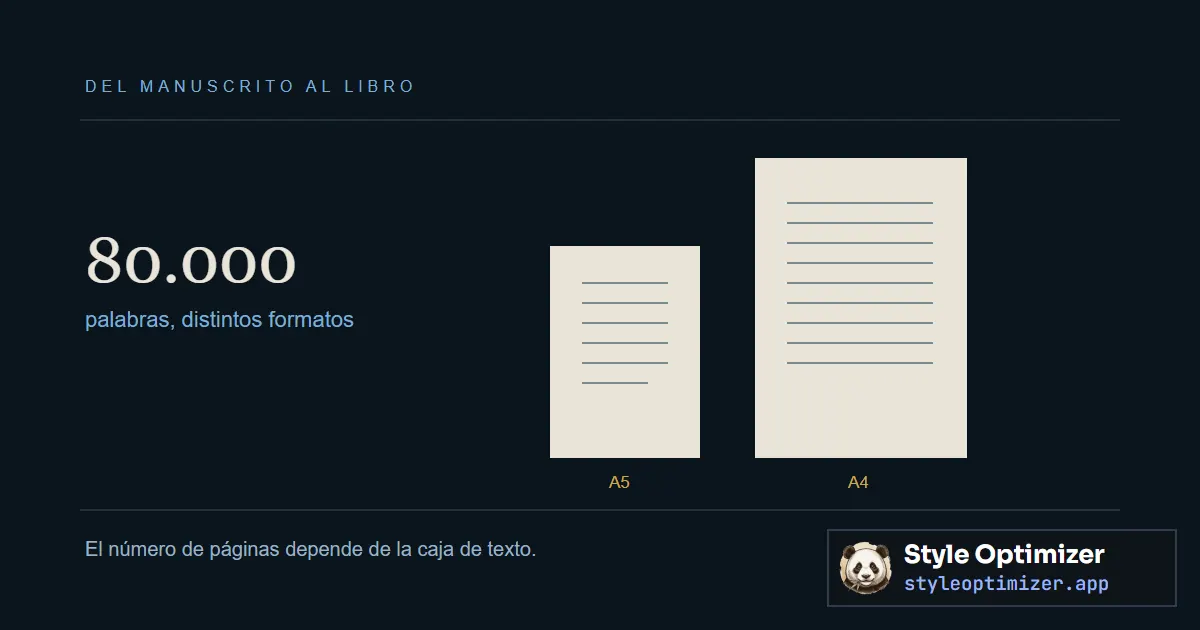
There’s no fixed conversion between words and pages. The same manuscript changes length when the trim size, the font, the margins or the paragraph layout change. As a starting point, a printed book of fiction holds roughly 250 words per page at 5×8 in, 310 at 5.5×8.5 in and 375 at 6×9 in, and a manuscript in standard format holds about 250. Use those figures to plan, and take the real page count from your final, typeset file.
How to estimate your book’s page count
- Start from your word count. Any word processor gives it to you. It’s the one figure that stays fixed whatever the format.
- Choose the page you’re counting. A manuscript page (what agents and contests receive) and a printed book page are different things, so decide which one you need before you convert.
- Divide by words per page. Use the table below for your trim size, or the manuscript figure of 250.
- Adjust for your layout. Lots of short lines of dialogue leave half-empty lines at the ends of paragraphs, so a dialogue-heavy book runs longer than a block of continuous prose.
- Add the pages you already know about. Title page, copyright page, table of contents, part openers and blank pages are counted separately from the text.
Manuscript pages: about 250 words each
Standard manuscript format (a 12-point font such as Times New Roman, double-spaced, with 1-inch margins on letter-size paper) gives roughly 250 words per page. That’s why a 100,000-word novel is often described as a manuscript of around 400 pages. The figure is a publishing convention more than a measurement, and agents and editors judge length by word count, so put the word count on your query and your title page.
Why we give a range
A word count doesn’t tell you how long each word is or where each paragraph ends. Two texts of the same length can fill a different number of pages. The figures below approximate how much text fits on a page and then allow 20% more or less text per page. That margin is a planning allowance.
The central figure helps you compare one setup with another. The low end assumes more text fits on each page; the high end, less. For a print order, a cover or a strict contest limit, always use the page count of the final file.
Words per page by trim size
These estimates assume an 11-point Garamond with 1.15 line spacing, which fits roughly 11 words per square inch of text area. For book trim sizes we assumed margins of 0.75 in on every side, closer to a printed book than the 1-inch margins of a manuscript. Your real figure depends on your font, margins, line spacing, chapter openings and how much dialogue you write.
| Trim size | Text area | Words per page (range) |
|---|---|---|
| 5 × 8 in | 3.5 × 6.5 in | About 250 (200–300) |
| 5.5 × 8.5 in | 4 × 7 in | About 310 (250–375) |
| 6 × 9 in | 4.5 × 7.5 in | About 375 (300–450) |
| Manuscript, 8.5 × 11 in | 6.5 × 9 in, double-spaced | About 250 (convention) |
How many pages is my book? Conversion table
Estimated pages with the assumptions above. Each cell gives the central figure and, in parentheses, the range. The manuscript column uses 250 words per page.
| Words | 5 × 8 in | 5.5 × 8.5 in | 6 × 9 in | Manuscript |
|---|---|---|---|---|
| 10,000 | 40 (33–50) | 33 (27–41) | 27 (23–34) | 40 |
| 30,000 | 119 (99–149) | 97 (81–121) | 80 (67–100) | 120 |
| 50,000 | 198 (165–248) | 161 (134–201) | 134 (112–167) | 200 |
| 80,000 | 317 (264–396) | 257 (215–322) | 214 (178–267) | 320 |
| 100,000 | 396 (330–495) | 322 (268–402) | 267 (223–334) | 400 |
| 120,000 | 475 (396–593) | 386 (322–482) | 320 (267–400) | 480 |
If your printer uses a trim size between two of these, read the closest smaller one: a larger page holds more text, so your book will come out a little shorter.
An example: 80,000 words in three trim sizes
Keep 80,000 words, the same font, the same line spacing and the same margins, and switch from 6×9 to 5×8. The text area shrinks, and the book grows from about 214 pages to about 317. Now widen the margins: the effect is proportionally larger on a small page, because the margins take up a bigger share of it.
Finally, compare a compact layout with one full of dialogue. The word count doesn’t change, but partly empty lines still take up space. That’s why “a page is so many words” only works once you’ve defined which page and which text you’re counting.
What changes the page count
- Trim size and margins: together they set the width and height available for text.
- Font size and line spacing: they decide how tall each line is.
- Typeface: some fonts are wider than others; an estimate uses an average width instead of setting the text letter by letter.
- Paragraphs: short or dialogue-heavy paragraphs use each line less efficiently.
- Front and back matter: added on top of the text pages.
What an estimate leaves out
Images, tables, footnotes, poems, long chapter titles, chapters that always start on a right-hand page and fixes for widows and orphans can all change the length considerably. Swapping in a different font when yours isn’t installed can also change the real layout. And resist shrinking the type or the margins until the book is uncomfortable to read just to hit a target number.
How to calculate spine width
Spine width depends on the number of sheets and the thickness of the paper. Each sheet carries two pages, so the calculation is: pages divided by two, times the thickness of one sheet.
With 320 pages and paper that’s 0.12 mm (about 0.0047 in) per sheet, you get 160 sheets and a spine of roughly 19 mm, or 0.76 in. That thickness is only an example: it changes from one paper stock to another, and some printers give a thickness per page instead of per sheet, in which case you multiply the page count by it directly. Check your printer’s spine calculator or cover template for the real figure, and calculate it from the final page count, since a few extra pages already move it.
How long is a typical book?
These are rough ranges; every publisher and every genre has its own:
- Novella or short novel: 20,000 to 50,000 words.
- Novel: 60,000 to 100,000 words.
- Fantasy and science fiction: often over 100,000 words.
- Popular nonfiction: 40,000 to 80,000 words.
Contests and submission limits
A page estimate is a first orientation; it can’t confirm that you meet a contest’s rules or an agent’s guidelines. If they require a specific format, set up that format and check the document or PDF you’re going to send. If they set a word limit, count words, because a page estimate doesn’t replace that requirement. There’s no universal submission format, and our guide to submitting a manuscript covers the rest of the package.
From estimate to layout
Once you know your trim size, pour the real chapters into it in your layout program and check how they fall on the page. From that moment on, the typeset file is the one that gives you the page count for the spine, the cover and the print quote.
If you still have part of those pages to write, our guide on how to write a novel helps you plan the rest, and novel structure shows how to divide the book into parts.
Book page count: FAQ
How many words are in a 200-page book?
With the assumptions above, about 50,000 words at 5×8 in, 62,000 at 5.5×8.5 in and 75,000 at 6×9 in. As a manuscript, 200 pages are about 50,000 words. A different font or different margins change those figures a lot.
How many words fit on a page?
About 250 on a 5×8 page, 310 on 5.5×8.5 and 375 on 6×9, with an 11-point font and 1.15 spacing. A double-spaced manuscript page holds about 250.
How many pages is 2,000 words?
About 8 manuscript pages, or roughly 5 to 8 printed pages depending on the trim size: about 8 at 5×8 in, 6 or 7 at 5.5×8.5 in and 5 or 6 at 6×9 in.
How do I work out the spine width?
Start from the final page count, divide it by two to get the number of sheets and multiply by the paper thickness your printer gives you. Most printers also offer a spine calculator or a cover template with the width already worked out.