Book club questions that actually spark discussion
October 8, 2026 · Equipo Style Optimizer
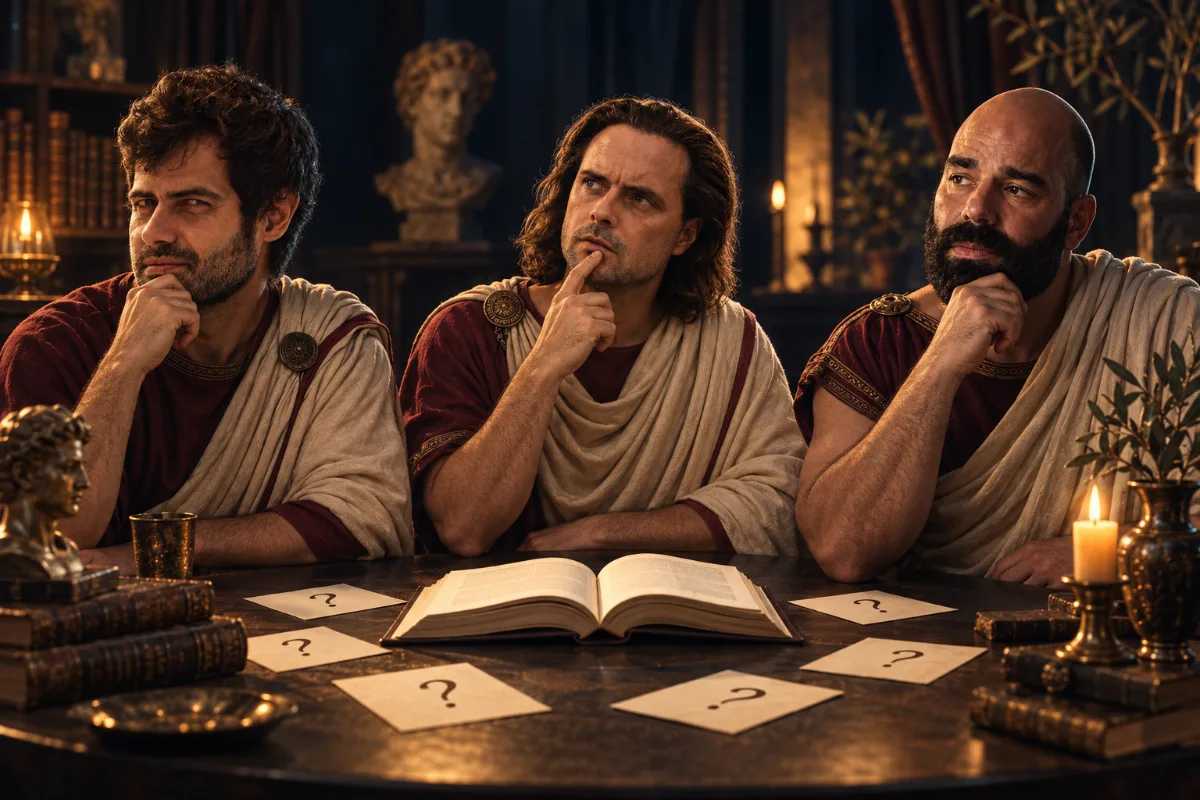
The best book club questions point to a decision the book makes, allow answers that can't all be true at once, and give readers a way back into the text. Checking whether everyone followed the plot is a different job. "Did you like it?" can break the ice, but it rarely carries a conversation.
This guide collects questions you can adapt to novels, short stories, essays and biographies. You don't need to use them all. Pick two or three that fit the specific book, let the answers lead to follow-up questions, and hold on to the ones that reveal a real disagreement.
What makes a good literary question
A productive question has three qualities. It's specific: it points to a scene, a relationship, a formal choice or an idea. It's debatable: two attentive readers can answer it differently. And it's arguable from the text: it makes people explain where the evidence is.
That's why "Who is the protagonist?" works for recalling information, while "At what point does the protagonist lose control of their own story?" requires interpreting structure and behavior. The second question allows disagreement without turning the conversation into a contest of tastes.
General questions that work for almost any book
- What does the opening promise, and how far does the book keep that promise?
- Which scene contains the conflict of the whole work in miniature?
- Which character understands least what's going on?
- What silence or absence weighs more than what's explained?
- Where does our opinion of a character or an idea change?
- Which of the author's decisions seems risky, and what does it gain in return?
- Is there a moment where the book insists too much?
- Which part would most clearly divide two reasonable readers?
- What other work is it in conversation with, even without mentioning it?
- Who would you recommend the book to, and who wouldn't you?
Questions about characters
Avoid reducing a character to a list of adjectives. Ask about desires, behavior and consequences: What do they want? What do they refuse to admit? What do they do when no one is watching? Who pays the price for their decisions? A character can be unpleasant and extraordinarily well built; separating likability from effectiveness heads off a lot of false arguments.
- What contradiction makes the main character recognizable?
- Which relationship forces them to behave differently?
- Which of their changes feels earned, and which feels imposed?
- Which secondary character changes how we read the protagonist?
- Does the novel understand its characters or judge them?
Questions about narrator, structure and prose
A book club can talk about more than what happens. Who tells the story, and what can't they see? Why does a piece of information appear at that moment? What effect does a long sentence, an ellipsis or a repetition have? You don't need academic terminology; it's enough to connect a formal choice with its consequence.
- What would the book lose if another character told it?
- In which scene does the pace change, and why?
- What information is held back effectively?
- Where does the prose make us look at something we'd normally ignore?
- Are there images, words or gestures that change as they repeat?
Questions for an essay or a work of nonfiction
With an essay, it helps to separate the thesis, the evidence and the persuasive power of the writing. A memorable example doesn't necessarily prove a general rule. Ask what central claim the book makes, what evidence supports it, which voices are left out and what would have to be true for the conclusion to be wrong.
The form is also worth discussing. Does the account of personal experience help readers understand the argument, or replace it? Does the clarity shed light on a difficulty or simplify it? Does the author present the position they want to refute fairly?
How to moderate without turning the meeting into an interrogation
Start with an accessible question and save the most divisive issue for when the group has already found its footing with the book. Don't work through a complete list. If an interesting difference comes up, ask "What part of the text leads you there?" or "What would have to change for you to think the opposite?"
The moderator's job is to share out the floor, tell apart two arguments that sound alike, and bring the conversation back to the book when it drifts too far into generalities. Settling every disagreement is optional. A good ending doesn't require consensus either: it can simply note which question was left open.
When an opinion becomes criticism
Saying a novel feels slow describes an experience. Criticism begins when you locate where that slowness appears, what mechanism produces it and whether it serves a purpose. Our guide on how to write a literary review can help you organize those observations and build a reasoned assessment.
Written discussion works the same way. When several readers comment on the same book theme by theme and keep their contributions visible, anyone can check how the group reached its conclusion, and the disagreements stay on the record instead of disappearing behind a single review.
Frequently asked questions
How many questions should I prepare for a book club?
For a regular session, four to eight is usually enough. It's better to dig into an unexpected answer than to get through a list that's too long.
How do I avoid awkward silences?
Ask a specific question, give people a few seconds to go back to the passage, and allow a short first answer. Double-barreled or overly abstract questions tend to shut people down more than they help.
Should spoilers be allowed?
If everyone has finished the book, yes: the ending lets you reinterpret the beginning. If the group is reading in installments, limit the questions to the agreed-upon section.